The Americana

Otenophores

I’m working on another Flickr set of public domain images—this time, ones from The Americana: A Universal Reference Library Comprising the Arts and Sciences, Literature, History, Biography, Geography, Commerce, etc., of the World, Vol. 21 (Triennial Act–Vivianite), edited by Frederick Converse Beach (New York: Scientific American Compiling Department, 1912).

Extracted, cleaned up (as best I could; most of them suffered from a particularly nasty pink-and-green moiré), captioned, and tagged for your pleasure. Go forth and repurpose them in peace.

I’ve downloaded a lot more old encyclopedias to cannibalize after this one. Idle time is the only constraint. Watch this space!

Other public domain Flickr sets:

A PSA to U.S. publishers that do not have legal departments

(and to anyone else in the United States who hires freelance designers):

If the designer of your book’s jacket or interior is not an employee of your company, rather than an independent contractor, and if you do not have a written contract that expressly says that the design work was done “for hire,” then you do not own the design.

This means that if you or anyone else wishes to reuse it—say, if you sell paperback or foreign rights to another publisher—you can’t just send along the layout files. You do not own them. They do not belong to you. You must negotiate a usage fee with the designer. It will probably cost you money.

Ouch.
Continue reading “A PSA to U.S. publishers that do not have legal departments”

Now’s your chance

red pencil

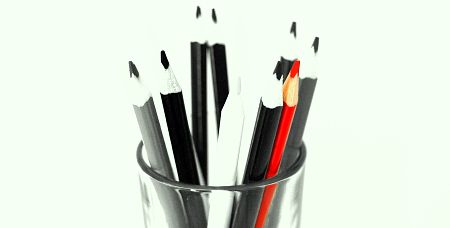
Remember Merrill Perlman, the New York Times copy queen who did a loooooong Q&A last year? Well, she’s just started another one: Talk to the Newsroom: Director of Copy Desks Merrill Perlman. So now’s your chance to have those burning editorial questions finally doused. One of my esteemed former colleagues at St. Martin’s has a question right on the first page:

A Vanishing Breed?

Q. I’m a managing editor at St. Martin’s Press in New York City. We are having more and more trouble finding literate freelance copy editors and proofreaders — people who know the basics of punctuation, spelling, grammar, something of what the English language can or can’t do, perhaps enough knowledge of a major European language to add an accent or make a past participle agree with a noun. Are newspapers experiencing the same problem, and if so, how are you dealing with it?
— Robert Cloud

A. You’re right, Mr. Cloud, it’s harder to find people who know what good copy editors need to know. You can argue that English usage has gone downhill, or you can argue that English is changing, but a better answer, I suspect, is plus ça change. . . .

Note that although Ms. Perlman is, of course, answering many general questions about copy editing, her primary field of expertise is newspaper style, and the Times‘s flavor thereof in particular. Should you have questions relating specifically to U.S. trade book style, you might want to ask the wonderfully salty Chicago Manual answeristas instead.

Photo: colour me red by :: Rick :: / Rick Truter; some rights reserved.

Meet me at the Pilcrow & Capitulum

pilcrows

Like most punctuation, the paragraph mark (or pilcrow) has an exotic history. It’s tempting to recognize the symbol as a “P for paragraph,” though the resemblance is incidental: in its original form, the mark was an open C crossed by a vertical line or two, a scribal abbreviation for capitulum, the Latin word for “chapter.” . . .

In any case, Pilcrow & Capitulum would make a fine name for a pub . . .

—Jonathan Hoefler at Typography.com. I like the way this man thinks.

¶ I enjoy using pilcrows (HTML entity ¶, in case you want one of your own); perhaps we need to find some new uses for this character.

¶ I mean, besides the obvious—T-shirts!

Another sliver of history

Torpedoes

I’ve been working on cleaning up another set of public domain images and posting them to Flickr, and my plan was to unveil them all at once when I’d accumulated a nice, fat stack comparable to this earlier collection. I’m really, really busy this month, however, and I’m afraid I won’t get back to this project for a while, so here’s an aperitif, in the meantime: Selected illustrations—editorial and commercial—from the San Francisco Call, which was published from 1895 to 1913. The newspaper came to my attention via the famous Alberto Forero, who posted a great illustration of hands to his massive collection of Flickrized antiquities back in January. I asked where he’d found it, he sent me the link, and there went my next week and a half. Thanks a lot.

This newspaper—which I’d never even heard of—published so many fantastic illustrations during just the first month of 1900. Take this gorgeous full-page gangster by Methfessel, for example; or these dissolute gamesters by Cahill; or this fluid sketch; or the adorable torpedoes above. And don’t even get me started on the advertisements for quacky gadgets and rather dubious medicines.

I’m still adding captions, tags, and URLs, and eventually I’ll post more images to this set, but I wanted to at least begin to release these into the wild. If you like this kind of stuff, be sure to check out Alberto’s many awesome photo sets. Just don’t blame me if you lose a couple of days or weeks down in that rabbit hole—remember, it’s all Alberto’s fault.

The most expensive India, Ink., post of 2008?

Cash Register

Typographica has posted its fourth annual Favorite Typefaces collection, and for possibly the first time ever, I already own one of the chosen few: Leitura, which I purchased last summer during Dino dos Santos’s krazy half-price sale and even actually used for a project. The other winning typefaces that I covet most fervently are Feijoa and FF Meta Serif, as well as Minuscule and National.

From the honorable mention list, I’ve got itchy add-to-cart fingers over Chronicle, Karmina, Declaration Pro, and Parcel.

Which typefaces strike your fancy?

Photo: register 004 by dogwelder / Luke Gattuso; some rights reserved.

The Charles Montgomery Burns Award for Blogging

Last week Stephen Tiano was so kind as to select this blog as one of ten he rated “Excellent,” as part of a pay-it-forward linky thing. Thanks, Steve!

I’m not sure I like the Enron-style logo for the project—

Excellent blog logo

—but I certainly appreciate the kind notice.

Some of the relevant sites that I follow have already been flagged for this thing:

I Love Typography
words / myth / ampers & virgule
Publishing Careers
The Penguin Blog

and I’ve discovered a few new ones by clicking back through the previous honorees. Yay! That’s the point.

But here are ten that I don’t think are duplicates:

  • Cozy Lummox — Eric Skillman’s design process blog. Eric is becoming, like, totally famous.
  • Zina Saunders @ Drawger — Not only beautiful artwork, but also interesting interviews with artists and art directors
  • Right-reading — Tom Christensen’s eclectic mix of mostly book-related stuff
  • Smashing Magazine — Is it a blog? Is it a magazine? I don’t know, but it’s been really useful.
  • Bittbox — Strangely impersonal—posts are written in the first person, but I can’t figure out who that “I” refers to—but, again, who cares? Lots of useful stuff.
  • Copyranter — Possibly the only upside to the world’s being plastered with advertising is that it fuels a constant stream of criticism from Copyranter, much of which amuses me. (As a bonus, his office is somewhere within a block of mine—maybe in the same building—so I’ve winced firsthand at many of the ads he skewers.)
  • Coudal Partners — “If browsing around here while at work has had a negative effect on your productivity we’re sorry but imagine what it’s done to ours.” No kidding. I find it hard to believe that they’re actually a functioning design firm, with all the blogging they do.
  • Chris Glass — I don’t know how Chris gets any work done, either, but he’s got a great del.icio.us feed, and now also a glass tumblr.
  • Elisabethsblog — Okay, so it’s in Norwegian (how peculiar!); but most of the sites she highlights are in English, so just click each link and see where you end up.
  • Throwing Music — Totally off-topic, but as I mentioned over at Clusterflock, I am really in love with the writing of Kristin Hersh (of the bands Throwing Muses and 50FootWave, as well as a distinguished solo career). She sends out gorgeous letters to her e-mail list, too. Today’s was brilliant.
  • Clusterflock — Which it’s “a group blog dedicated to pretty much everything; by people you would like to meet at a party; . . . dedicated to culture: art, design, music, food, architecture, science, travel, movies, books, typography, politics, etc.; inclusive of geezers!; a delightful mixture of orange words and pictures of well, the insides of a stuffed animal—delightful all the same.” Something for everyone, though perhaps not all on the same day.

Um, okay, that was eleven. But this kind of thing is extremely difficult for a scatterbrain who has more than 400 feeds in her RSS reader. Ask me again tomorrow; I’ll have a different list.

The Motherlode of Vintage Bookbinding History

swirly bindings

Earlier this week, Miss Sheila Ryan, archivist extraordinaire, drew my attention to the 2008 winner of the award for Best Online Archival Exhibition, as reported by Kate Theimer at ArchivesNext.com: “Publishers’ Bindings Online, 1815–1930: The Art of Books,” created by the University of Alabama, University Libraries, and the University of Wisconsin-Madison Libraries.

It has taken me so long to blog the news because this collection is sick—sick, I tell you: more than five thousand books, in various states of decay. Some are fabulous; some are homely; it would take weeks to look at them all. Every time I thought I had a good selection with which to illustrate this post, I’d find twenty more that I love.

The only problem with this archive? You can’t bookmark specific pages within the collection, as you have to have a valid session ID. And if you let your browser sit idle for too long, your session times out. Maddening! If anyone can find a way around this, please let me know. I’ve been dumping covers into Flickr so I can find them again.

More samples after the jump . . .
Continue reading “The Motherlode of Vintage Bookbinding History”