Old essay on new black face

Neuland and Lithos on black books

I suspect that designers who use Neuland or Lithos as an approximation of the Africanesque are being unimaginative at best, and jingoistic at worst. —Jonathan Hoefler

This article by Rob Giampietro of Giampietro + Smith has been around for a while—having originally been published in Letterspace in 2004—but I didn’t see it until Brian Feeney blogged it, so maybe you haven’t, either.

Since I read it, about three weeks ago, I’ve been noticing these typefaces everywhere (though slightly less often than I spot Papyrus), used in exactly the way Giampietro describes. Quit it, people.

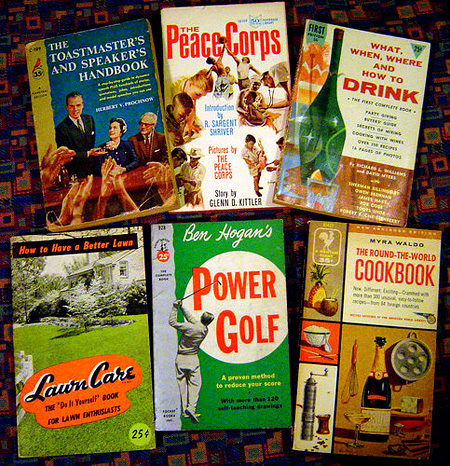
Cheap Paperbacks

useful paperbacks

Today is your last day to buy Dino dos Santos’s typefaces at 50 percent off, but you have an entire month to scoop up goodies from House Industries at a discount.

Sale items include Neutraface, which I’ve had to work with several times and been annoyed by (something about unthoughtful OpenType setup—two jobs ago; I’ve forgotten now), but which some people like the look of, and Chalet, which I remember there being a lot of buzz about when it came out.

What I’m most interested in, though, is Paperback by John Downer (whose TypeCon presentation was one of the ones that made me cringe painfully; but I’m sure he’s very good at designing type). I first read about this when I was designing a lot of swill, and it sounded to me like a useful typeface to have.
Continue reading “Cheap Paperbacks”

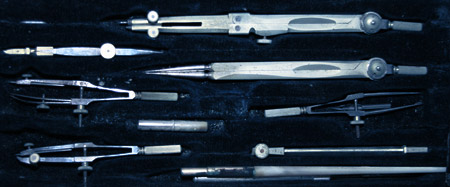
The Museum of Forgotten Art Supplies

drafting tools

I can’t imagine how rubber cement—and its attendant erasers and thinners (oh, how I love those cans!)—could ever go out of circulation, and I can prove that I’ve used a type gauge pretty recently (in fact, I’ve been meaning to go buy a new one; and a loupe), but I’m still charmed by Lou Brooks’s The Museum of Forgotten Art Supplies.

I ran across my erasing shield from high school drafting a few months ago. I could probably use that when erasing ill-considered proofreading marks. And I’d certainly have a “Pantone Thing” if I could afford one.

How many items exhibited in the museum have you owned?

(Via pica + pixel.)

Photo: Drafting Tools by Generation X-Ray / Paul; some rights reserved.

TypeCon 2007 in 100 words or less

detail of typo-peppered map in Freeway Park, Seattle

“I love Quark, but . . . at some point you gotta stop hitting yourself on the head with a hammer.”

Calli means ‘good’ and graphy means ‘writing,’ so calligraphy means ‘beautiful writing.’ Isn’t that neat?”

Because some users don’t know how to type curly quotes instead of straight ones, you should make fonts whose straight quotes are the same as the curly ones—are you !@#$% kidding me?

Cabarga talks softly, is clever with Illustrator.

Elements 3E signed by Bringhurst!

Hotels with lousy Internet must die.

Many pretty Mexican typefaces.

Anything is interesting for only twenty minutes—almost.

Creepaway Camp

Nextbook.org home page: July 30, 2007: summer camp

Back when I was first asking y’all about how you find illustrators, I stumbled across illoz.com, a cool portfolio site with some handy art direction tools built in. I signed up, and since then I’ve made a lot of folders in my illoz account, with lots of samples by people whose work I like. But not until two weeks ago did I find an artist whose work I thought would be the perfect match for a specific story.

story illustrator
is about a girl at camp, mostly takes place in woods draws a lot of girls in woods
is creepy can draw very creepily

I confess that I didn’t contact Sam Weber using the lovingly designed art direction interface on illoz.com, though it certainly sounds nice—

An art director account at illoz gives you the ability to initiate project assignments with any illoz portfolio owner. Sketches can be viewed here at the site, then commented on and approved. After that, final art can be downloaded directly from a portfolio owner’s personal area. The job can go from start to finish, right here at illoz.

I think the thing is, I’m a socially challenged geek to begin with, and I’d always rather contact someone through a structured form than by phone or e-mail, so I try to fight that tendency by occasionally picking up the phone, instead. Not that I picked up the phone in this case, either. But I did write a long, no doubt overly detailed e-mail directly to Sam, mentioning that I’d found him on illoz. And he wrote back! And he accepted the job! And he did it very quickly! And I love it! And it’s on our home page until tomorrow morning, and in the story indefinitely!

So, that’s my illoz success story.

The story Sam illustrated, incidentally, is by my colleague Ellen, and I think it’s really good. You should read it if you’re, you know, one of the few designer-types who knows how to read.