Nose Job

Nextbook.org home page, September 19, 2007

Vanessa Davis did this illustration for us months ago, and then the story got pushed to November for some reason. But then today’s story wasn’t ready in time, so at the last minute, the editors swapped this one in. I’m so glad it’s finally up!

I really liked the preliminary sketch for this and couldn’t imagine how the final illustration would improve on it. Well, I guess I’m just not very imaginative, because it improved a lot. You can see the complete piece on the story page. It’ll probably get knocked out of the main home page slot tomorrow, unfortunately.

(I know it seems like it’s all Vanessa Davis, all the time around here, but really, I am commissioning work from other artists.)

The A Rate

Best rices in town

Somewhere once, I want to say it was in a Ruth Birmingham mystery, a former colleague found a passage about the different rates the private investigator would charge. This passage was read aloud to me, and I don’t know about you, but I find it difficult to remember things I hear rather than read on paper; but in my probably flawed memory there were three tiers of fees: the B, or basic, rate; a lower rate for nice people or those especially in need, which may have been C for crazy (which doesn’t quite make sense—part of why I don’t trust this paraphrase); and the A, or Asshole, rate. The latter is the only part I’m sure of, because to this very day, that friend and I joke about charging certain clients “the A rate.”

In practice, of course, neither of us does this. (In my case, this is mostly because I tend to work for friends, who say to me, “This is all the money we have/are allowed to pay. Is that enough?” And it’s often not, but they’re my friends, so I do it anyway.) But some people do, and more power to them. Do you?

Via Tiny Gigantic, who propose a more mature and sensible way of coming up with fees.

Photo: Best rices in town by juicyrai / al; some rights reserved. See also: Prices by vasta.

Interview with James Victore

Victoremobile

I’d never heard of James Victore before, but I enjoyed reading this.

I had one instructor in my second year, the graphic designer Paul Bacon. He gave me a D. But when I dropped out of school, I went to his office and said that I’d like to apprentice. I didn’t even know what it meant, but I wanted to apprentice with him. He looked at me and put his pen down and told me that no one had ever asked him that before. Then he agreed to let me do it. I learned a huge lesson at that moment: You have got to ask. I got that apprenticeship because no one else had ever asked. So I started hanging out in Paul’s studio, looking over his shoulder. I’d get there in the morning and sweep; I didn’t really have any jobs. And then I’d hang out. When a desk became available, I tried to do some “real” design. Three months after I dropped out of SVA, I had put together a portfolio with three fake book jackets. I started showing my portfolio, and I got hired right off the bat. I’ve been working ever since.

Continue reading “Interview with James Victore”

Know Your Competition

street arm wrestling

I was going to delete this spam comment (which I’ve received twice now) without remark—

Author: Francisco Quia-ot
E-mail: francisco@datastyling.com
URL: http://www.datastyling.com

Comment:

SUBJECT:
Hire our employee for only $590/month (6 days/week/8:00 am – 5:00 pm).

MESSAGE:
Welcome at datastyling.com

Having an appealing and eye catching book cover design and a book interior design that is consistent with the cover will really make a difference in the success and marketability of your book. We look forward to hearing from you and creating a beautiful book cover and/or interior for you.

Please email(francisco@datastyling.com) for more details.

—but then I thought, Wait, maybe this company actually exists.
Continue reading “Know Your Competition”

Why join AIGA?

clubhouse sign

A few weeks ago, I got a wild hair you-know-where to join AIGA, “the professional association for design.” I figured I’d join for a year, go to all the NYC events, participate as much as I could stand, and then reup only if it seemed valuable.

So I poked around on the AIGA and AIGA/NY websites to refresh my memory on what they do, and then I went to the membership sign-up section. And then my wild hair totally unkinked itself.

$295 a year? Oh, never mind. I guess I’m not serious about design, after all.
Continue reading “Why join AIGA?”

Old essay on new black face

Neuland and Lithos on black books

I suspect that designers who use Neuland or Lithos as an approximation of the Africanesque are being unimaginative at best, and jingoistic at worst. —Jonathan Hoefler

This article by Rob Giampietro of Giampietro + Smith has been around for a while—having originally been published in Letterspace in 2004—but I didn’t see it until Brian Feeney blogged it, so maybe you haven’t, either.

Since I read it, about three weeks ago, I’ve been noticing these typefaces everywhere (though slightly less often than I spot Papyrus), used in exactly the way Giampietro describes. Quit it, people.

Cheap Paperbacks

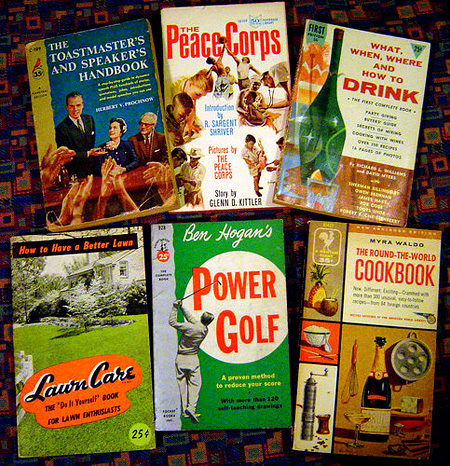
useful paperbacks

Today is your last day to buy Dino dos Santos’s typefaces at 50 percent off, but you have an entire month to scoop up goodies from House Industries at a discount.

Sale items include Neutraface, which I’ve had to work with several times and been annoyed by (something about unthoughtful OpenType setup—two jobs ago; I’ve forgotten now), but which some people like the look of, and Chalet, which I remember there being a lot of buzz about when it came out.

What I’m most interested in, though, is Paperback by John Downer (whose TypeCon presentation was one of the ones that made me cringe painfully; but I’m sure he’s very good at designing type). I first read about this when I was designing a lot of swill, and it sounded to me like a useful typeface to have.
Continue reading “Cheap Paperbacks”

The Museum of Forgotten Art Supplies

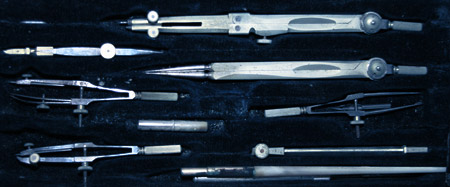
drafting tools

I can’t imagine how rubber cement—and its attendant erasers and thinners (oh, how I love those cans!)—could ever go out of circulation, and I can prove that I’ve used a type gauge pretty recently (in fact, I’ve been meaning to go buy a new one; and a loupe), but I’m still charmed by Lou Brooks’s The Museum of Forgotten Art Supplies.

I ran across my erasing shield from high school drafting a few months ago. I could probably use that when erasing ill-considered proofreading marks. And I’d certainly have a “Pantone Thing” if I could afford one.

How many items exhibited in the museum have you owned?

(Via pica + pixel.)

Photo: Drafting Tools by Generation X-Ray / Paul; some rights reserved.