TypeConclusions

Looking back over the TypeCon program, it’s amazing to me how many sessions I missed. But, you know, the weather was beautiful, and I’m not much of a morning person. Or an evening person—I also blew off all the parties and field trips. (But I’m a regular ace at “Break for lunch on your own.”)

Of the talks I did attend, only one was so boring that I really fell asleep. But that one—woo! It was a doozy. I’ll just say that it cured me of any desire, however slight, ever to attend RISD. Then there were a couple of borderline presentations that were mostly interesting but a bit of a challenge to sit through in a dark, too-cool room. In most of these, it was a matter of quantity: twenty-five minutes would have been perfect; forty minutes was about thirty minutes too much. For example, I didn’t know jack about “The Wonderful World of William Addison Dwiggins” and enjoyed the first two presentations thereon pretty thoroughly. But approximately 237 pieces of fascinating ephemera into the third segment, I just had to stagger out. Couldn’t. Stay. Awake. Fortunately, when I got to the hang-out area, there were cookies! And tea!

Suggestion to organizers for next year: Have the tea trolleys roll up and down the aisles during the talks, for less attrition.
Continue reading “TypeConclusions”

Seen in the wild

(The wilds of my office, that is.)

The Affected Provincial's Companion

Today I received my preordered copy of Lord Whimsy’s The Affected Provincial’s Companion, and it is exceedingly lovely. I showed it to our production god, who had never seen a two-color stamp before and immediately thought it would be a nice look for some gift edition of something that’s in the queue. I asked him if it costs less to do an all-over case stamp than to print a jacket, and he was pretty sure that it was so. The foil is billed based on the area covered, so an all-over stamp will cost more than a spine alone, but stamping a spine costs only about $75, whereas making a single correction to a jacket—and how often is there just one correction?—costs $125. And that’s not to mention printing in four colors, embossing, and laying foil over that, all of which we often do.
Continue reading “Seen in the wild”

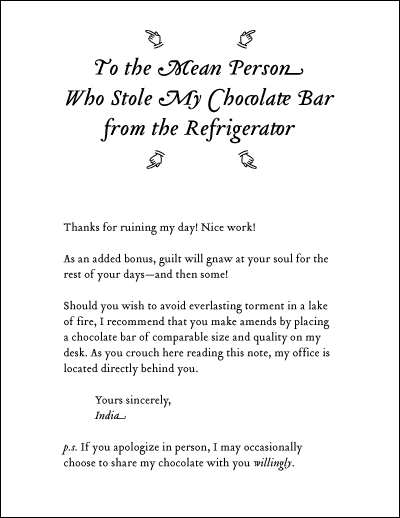
What is this, a college dorm?!

Thanks for ruining my day! Nice work! As an added bonus, guilt will gnaw at your soul for the rest of your days--and then some! Should you wish to avoid everlasting torment in a lake of fire, I recommend that you make amends by placing a chocolate bar of comparable size and quality on my desk. As you crouch here reading this note, my office is located directly behind you. Yours sincerely, India. p.s. If you apologize in person, I may occasionally choose to share my chocolate with you willingly.

The text shown above is set in Tribute, a type family designed by Frank Heine in 2003. It is available in PostScript Type 1 and OpenType versions from Emigre.

The chocolate (not shown) was a large bar of Belgian dark chocolate squares with praline centers. I placed it in the refrigerator because even with the air conditioner set to 76 degrees all day, the chocolate was liquefying in my desk drawer.

Designers vs. Illustrators (vs. Authors)

This is not really my field, as I’m not a cover designer, but the Guardian just posted a rant by an author with the teaser (sorry—there’s a proper term for this in newspaperspeak, isn’t there?), “Now that pixels have replaced pencils the art of drawing has vanished. I’m so exasperated I’m designing my own book cover.” Supposedly, after thirteen rounds of comps and despite specifically requesting a hand-drawn illustration, the author still has only been shown covers using photographs, and she concludes that this is because designers can’t draw.

Give me a fucking break.

As someone has already posted in the comments,

  1. Designers design; they don’t necessarily draw. That elusive artist you’re looking for is called an illustrator.
  2. If the author has been asking for hand-drawn covers and the designers aren’t providing them, after thirteen rounds, it’s the fault not of the designer but of the publisher, who either isn’t
    • stating this preference in the design brief, or
    • providing a budget for an illustration, which is billed separately

The book and publisher are not mentioned by name, but it’s probably The Post-Birthday World, forthcoming from HarperCollins. We’re talking about a design department run by people who create their own fonts. I can’t believe they’d balk at buying or drawing an illustration. There’s clearly some backstory here.

Cheats, Shoots, and Leaves

Update: Now, with sample pages!

Ever since I tried to roughly describe how I go about designing a book, my process has been changing. Mostly, it’s because I keep getting asked to design books (1) for which I don’t have an electronic file, and (2) that need to be shot down to mass-market size. In the last six weekdays, I did 3.5 designs, and I had electronic files for only the 0.5 part. The transmittal forms for two of these books said they were to be designed so that they could be shot down. What does this mean?
Continue reading “Cheats, Shoots, and Leaves”

A Hard Case

Update: Now, with pictures!

All right, kids. You like details? Here are some details.

Pick up three hardcover books, preferably from different publishers, and remove the dust jackets. Look at the spines. Do you see the title, author, and publisher’s name or logo stamped on each spine in metallic foil? Probably. Are the colors of the foil different—e.g., one’s silver, one’s gold, one’s copper? Right. Somebody picked those. And actually there are many shades of silver, gold, and copper to choose from—not to mention colored metallics and matte colors. Somebody designed the stamp—a die—to print the spine, too. Some publishers like to have it complement the interior design; others like for it to echo the jacket.

Spines
Spines of three of the more interestingly bound books in my possession. The top is from 1816. The middle is undated but probably from 1900 or 1901, based on cues in the content; it’s blind-stamped. The bottom is from 1954 and has raised cords.
Continue reading “A Hard Case”

Don't leave me dangling

Checking some proofs the other day, an error leaped out at me. Appearing on the acknowledgments page, I couldn’t help noticing this dangling modifier:

Like all other authors . . . , there are many others who helped me get this book together.

Leading a paragraph in which the author thanks his two proofreaders, I needn’t point out the irony of this error.

Can you see it? It’s a dangling modifier, and if the text of this post so far has set your teeth on edge but you can’t quite identify why, it may be because all three of my own sentences surrounding that quotation start with danglers. (To fix the quote, I’d recast the second part so that its subject is “I.”)

Here’s a dangler from a novel I set a few years ago (rendered from memory): Continue reading “Don't leave me dangling”

Ultrasparky makes my heart sparkle!

How interesting it’s been checking out all the Web sites that have been linking in since I got Kottked a week ago, and how sad it’s been to see the line on my WordPress traffic graph slope back down toward its normal point of zero. But today, today, my obsessive checking-out of every site listed on my referrer page paid off: I discovered Dan Rhatigan’s Ultrasparky, which is just delicious.

Hours and hours of happy reading.

J’adore.